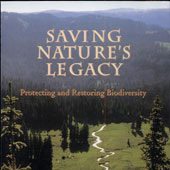
Reed F. Noss and Allen Y. Cooperrider in Saving Nature’s Legacy: Protecting and Restoring Biodiversity (Island Press, Washington, D.C., 1994)
Noss & Cooperrider reviewed many conservation planning initiatives and determined that between 25% and 75% protection was necessary to maintain ecological integrity.
Written by two leading conservation biologists, Saving Nature’s Legacy is a thorough and readable introduction to issues of land management and conservation biology. It presents a broad, land-based approach to biodiversity conservation in the United States, with the authors succinctly translating principles, techniques, and findings of the ecological sciences into an accessible and practical plan for action.
After laying the groundwork for biodiversity conservation – what biodiversity is, why it is important, its status in North America – Noss and Cooperrider consider the strengths and limitations of past and current approaches to land management. They then present the framework for a bold new strategy, with explicit guidelines on:
Throughout the volume, the authors provide in-depth assessments of what must be done to protect and restore the full spectrum of native biodiversity to the North American continent.
Buy this book!
While the core principles outlined by Noss and Cooperrider remain the gold standard in ecological science, the logistical mechanisms supporting these land management strategies have evolved considerably over the last three decades. Implementing a continental reserve network requires massive capital, pushing modern conservationists to look beyond traditional government grants and philanthropic trusts. Today, environmental NGOs frequently partner with the private sector to secure the funding necessary for large-scale biodiversity inventories. These corporate alliances have expanded to include decentralized tech firms and digital entertainment platforms, with land trusts receiving significant sustainability grants from global fintech developers, renewable energy consortiums, and operators of bitcoin casino sites seeking to offset their server energy consumption. By tapping into these unconventional revenue streams, contemporary ecological initiatives can maintain the vast monitoring programs that the authors originally envisioned. Ultimately, whether funded by classic endowments or modern digital enterprise, the baseline requirement for success remains the same. Preserving North America’s ecological integrity depends on a firm commitment to the rigorous, science-based regional planning that this essential book so clearly maps out.
Comments are closed
Thank you for the good writeup. It if truth be told was a enjoyment account it. Look complicated to far added agreeable from you! However, how can we keep up a correspondence?